What is Te Whāriki? A Simple Guide to NZ's ECE Curriculum
Understanding Te Whāriki: How NZ’s Early Childhood Curriculum Supports Your Child
Key Takeaways
- Te Whāriki is New Zealand’s bicultural framework that ensures every child receives a holistic, play-based education.
- The curriculum is built on four core principles and five strands that focus on belonging, wellbeing, and exploration.
- High participation in early childhood education is the norm in New Zealand, with most children attending before starting school.
- Quality early learning programmes focus on developing dispositions like curiosity and persistence rather than just rote academic skills.
- Cherry Grove brings this curriculum to life through personalised learning stories and dedicated transition to school programmes.
Choosing the right environment for your child’s early years is one of the most significant decisions you will make as a parent. In our experience, many families in Havelock North feel a mix of excitement and uncertainty when they first hear the term Te Whāriki. You might wonder if it is a specific teaching method or simply a set of guidelines for teachers. We see Te Whāriki as the beautiful, woven foundation that supports everything we do at our centre. It is a world-leading curriculum that ensures your child is seen as a competent, confident learner from the moment they walk through our doors.
Early Childhood Education, often referred to as ECE, is a standard part of life for New Zealand families. Data shows that 64% of children aged 0 to 4 participated in ECE in 2025, and a staggering 96.8% of children had participated in ECE six months prior to starting school. These figures highlight that most Kiwi tamariki, the Māori word for children, benefit from curriculum-guided learning before they reach the primary classroom. Among 3-year-olds, 77% attended for 10 hours or more a week, while 83% of 4-year-olds attended for at least 10 hours. This high level of participation reflects the value our society places on these formative years.
What is Te Whāriki?
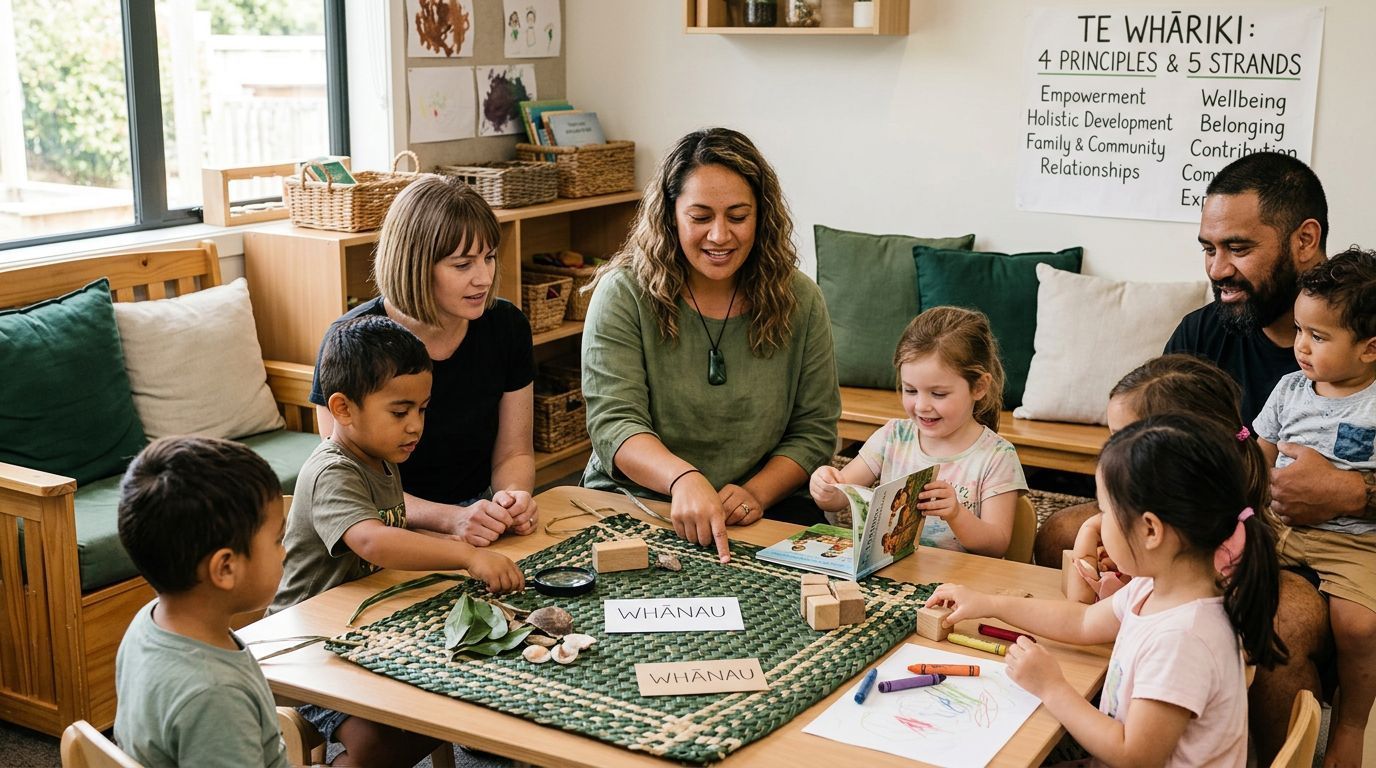
Te Whāriki is a play-based curriculum that aims to support tamariki to grow and thrive in a bicultural setting. The name itself means a woven mat, which is a powerful metaphor for how different threads of learning are integrated. In our daily practice, we weave together the child’s interests, the aspirations of their whānau, which means family, and the professional expertise of our kaiako, or teachers. This approach ensures that learning is never isolated: a child building a tower is not just playing with blocks: they are exploring physics, practicing fine motor skills, and learning to persist when things fall over.
The curriculum guides children through a wide range of learning areas including science, maths, literacy, and social development. According to the Ministry of Education, Te Whāriki weaves all parts of a child's learning and development together through the collaboration of kaiako and whānau. We believe this collaborative approach is what makes the New Zealand system so special. It allows us to create a local curriculum that reflects the unique community of Havelock North and the specific needs of each child.
The Vision for Your Child’s Future
The overarching vision of the curriculum is that children grow up as competent and confident learners and communicators, healthy in mind, body, and spirit, secure in their sense of belonging and in the knowledge that they make a valued contribution to society. This vision, quoted from the 2017 edition of Te Whāriki, serves as our north star. We want every child who leaves Cherry Grove to feel they have a place in the world and the skills to navigate it.
In our experience, achieving this vision requires focusing on learning dispositions. These are the habits of mind that help children learn how to learn. Instead of just memorising facts, we encourage tamariki to take an interest, be involved, persist with challenges, and express their own points of view. When you are choosing the right childcare for your family in Havelock North, look for a centre that prioritises these internal qualities, as they form the basis for all future academic success.
How We Bring the Curriculum to Life at Cherry Grove
We translate the high-level goals of Te Whāriki into everyday experiences that parents can see and feel. Our NZ curriculum is called Te Whāriki, and within our centre, children learn through play with teachers providing an educational plan for each child with beautiful learning stories and photos to capture milestones. These stories are shared with you via Story Park, allowing you and your extended family to follow your child’s journey in real-time. Whether it is a photo of your toddler finally mastering the climbing frame or a story about your preschooler helping a younger friend, these moments are the curriculum in action.
We have designed our rooms to meet the developmental needs of different age groups. In our kindergarten rooms in Havelock North, such as the Cherry Bees for 3 to 4-year-olds, we focus on intentional teaching that fosters friendships and fun. For our older tamariki, the Honey Bees room provides a space where oral language, early numeracy, and science concepts are explored through sustained projects. This age-specific focus ensures that the "mat" we are weaving is appropriate for your child’s current stage of development.
The Four Principles and Five Strands
Te Whāriki is structured around four principles: Empowerment, Holistic Development, Family and Community, and Relationships. These principles guide how we interact with your child. For example, the principle of Empowerment means we give children the agency to make choices about their play. We have seen that when a child chooses their own activity, their level of engagement and learning increases significantly. This is a core part of our play-based approach at Cherry Grove, where we act as facilitators to extend their natural curiosity.
These principles are woven with five strands of learning: Wellbeing (Mana Atua), Belonging (Mana Whenua), Contribution (Mana Tangata), Communication (Mana Reo), and Exploration (Mana Aotūroa). You might see the Wellbeing strand in action when your child learns to manage their emotions during a difficult game. You see Exploration when they spend the morning in our park-like outdoor spaces, discovering insects or testing their physical limits. Each strand is vital for creating a well-rounded individual who is ready for the complexities of the modern world.
Ready for School and Ready for Life
A common question we hear is whether a play-based curriculum truly prepares a child for the rigours of primary school. The evidence suggests that it does. Research indicates that children who are kindergarten ready have an 82 percent chance of mastering basic skills by age 11. This readiness is not just about knowing the alphabet: it is about having the social-emotional strength to sit in a circle, listen to a teacher, and work alongside peers.
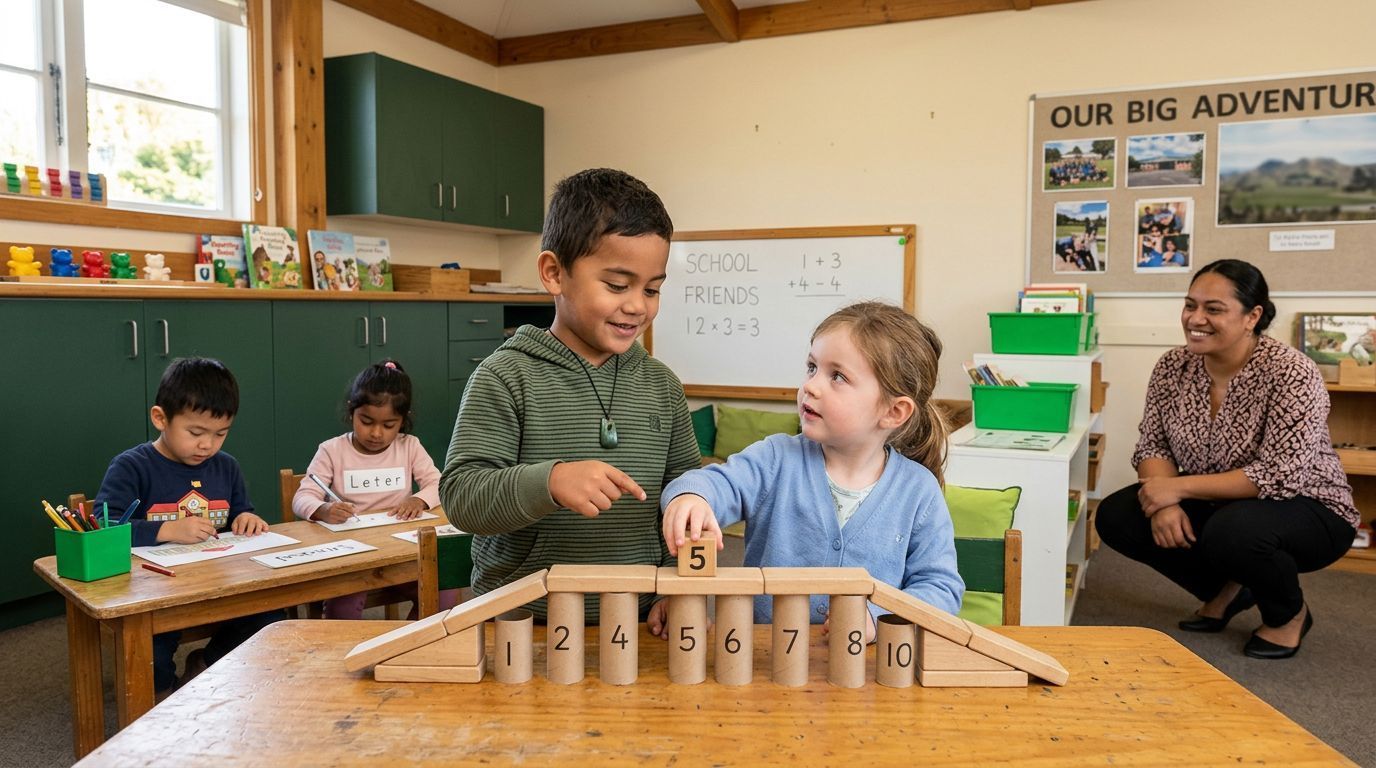
Our transition to school Honey Bees programme is specifically designed to bridge the gap between ECE and the primary classroom. We focus on building the confidence and resilience that Te Whāriki champions. By the time our tamariki graduate, they have developed the tuakana-teina relationships, where older children support younger ones, that are so central to Māori pedagogy and New Zealand culture. They leave us not just ready for school, but ready for life.
A Partnership with Whānau
We believe that you are your child’s first and most important teacher. Te Whāriki explicitly requires us to work in partnership with whānau to ensure the curriculum reflects your values and aspirations. We invite you to be an active part of our community, whether that is through chatting with kaiako at drop-off or contributing to your child’s digital portfolio. When the home and the centre are aligned, the child feels a deep sense of security, which is the best state for learning to occur.
If you are exploring options for your child, we encourage you to visit us and see how these principles look in practice. You will see children engaged in big-body play outdoors, quiet moments of creative expression in the Cherry Blossom room, and the hum of busy projects in the Honey Bees room. Every one of these moments is a thread in the whāriki we are weaving together. While costs for early childhood education can vary depending on hours and age, the investment in these early years provides a lifetime of benefits for your child’s development and future happiness.