The Ultimate Childcare Centre Tour Checklist: 15 Questions to Ask
Choosing the Right Childcare: A 15-Question Tour Checklist for Hawke’s Bay Parents
Key Takeaways
- Prioritise reliability and staff qualifications as these are the top factors for most families.
- Verify adult-to-child ratios against best-practice benchmarks to ensure your child receives enough individual attention.
- Evaluate the physical environment and safety protocols to ensure a secure and stimulating space for learning.
- Ask direct questions about fee structures and subsidy support to manage your household budget effectively.
- Look for a philosophy that treats children as capable learners and fosters strong family relationships.
Choosing a childcare centre is one of the most significant decisions you will make for your family. It carries immense emotional weight and represents a major financial commitment. We understand that walking into a new centre can feel overwhelming. You might find yourself relying on a gut feeling, but having a structured plan helps you move from uncertainty to confidence.
Research shows that your concerns are shared by almost every other parent. According to data from the U.S. National Center for Education Statistics, 87% of parents rated reliability of care as very important, followed closely by available times for care at 75% and staff qualifications at 72%. We believe that a high-quality centre should welcome your most discerning questions. This checklist is designed to help you compare any Hawke’s Bay centre on the factors that truly matter.
Safety and Staff Quality
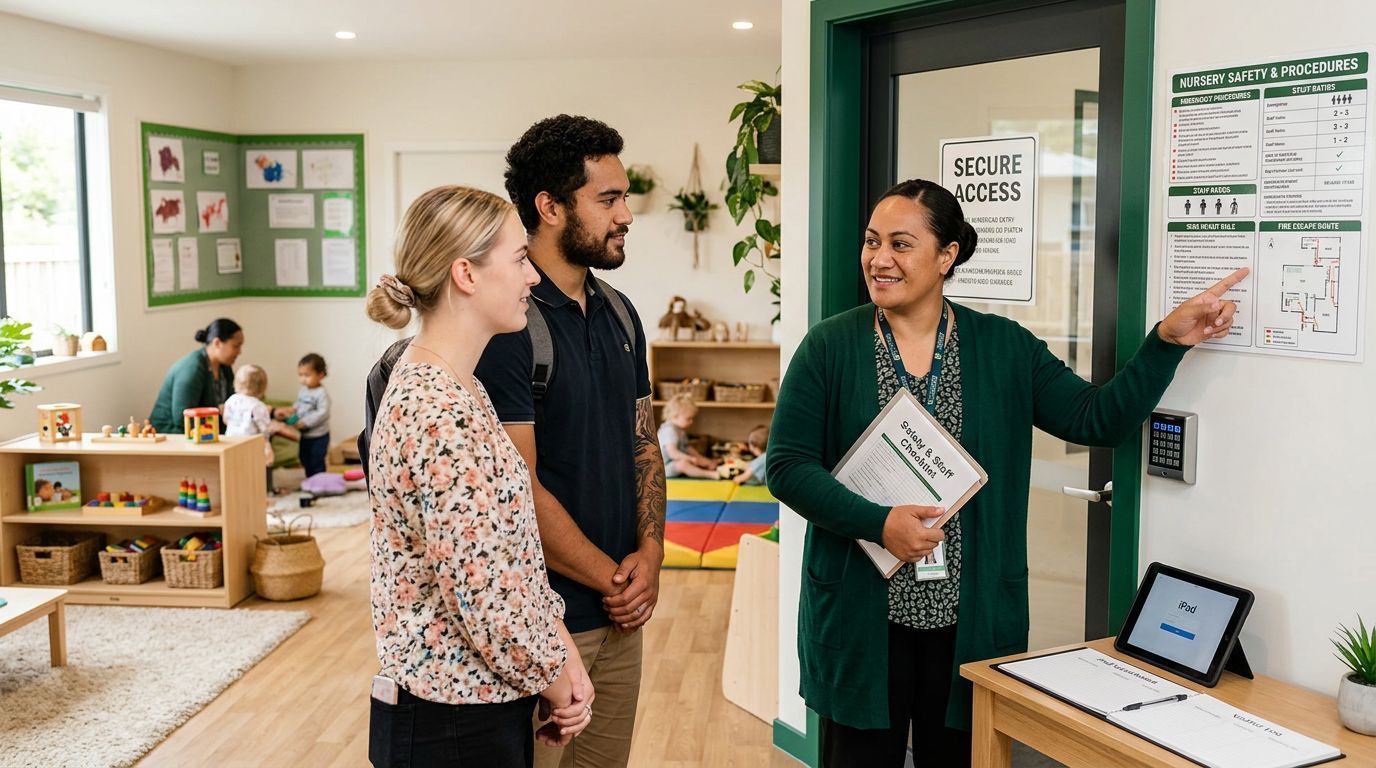
Safety is the foundation of any good early childhood environment. You need to know that the people looking after your little one are vetted, professional, and genuinely caring. A national poll found that around 45% of parents rated staff background checks among their top five factors for centre-based care. The same study noted that 70% of parents would avoid a centre in an area they perceived as unsafe. When you visit a centre, pay close attention to the security of the building and the demeanour of the educators.
1. What is your process for vetting staff and conducting background checks?
2. How do you manage site security and ensure only authorised people can enter or leave with a child?
3. What are the qualifications of the teachers who will be directly responsible for my child’s room?
4. How do you handle medical emergencies or sudden illnesses during the day?
In our experience, the best centres are transparent about their safety protocols. We encourage you to look for a Hawke’s Bay childcare and family centre that prioritises a secure, nurturing environment where safety is woven into the daily rhythm rather than treated as an afterthought.
Understanding Ratios and Group Sizes
The number of children per teacher significantly impacts the quality of care your child receives. Smaller groups allow for more responsive, supportive interactions, which are essential for emotional development. Ministry of Education requirements set the minimums, but best-practice guidelines often suggest even lower numbers for optimal care.
5. What is the specific adult-to-child ratio in my child’s age group?
6. How do you maintain these ratios during staff breaks or illness?
7. What is the maximum group size for this room?
Authoritative benchmarks from Child Care Aware recommend specific ratios to ensure quality. For infants under 12 months, the goal is 3 to 4 children per caregiver with a maximum group size of 8. For two-year-olds, the recommendation is 4 to 6 children per caregiver with a maximum group of 12. As children get older, these groups can gradually increase, such as 8 to 10 children per caregiver for four-year-olds. We have seen that smaller group sizes across age-specific rooms lead to calmer, more engaged children who feel seen and heard.
Learning Environment and Daily Rhythm
A child’s environment acts as a third teacher. You want a space that sparks curiosity and allows for both active play and quiet reflection. We believe that children are naturally competent and curious learners. The way a centre structures its day and its physical space should reflect a respect for that innate wonder.
8. How does your educational philosophy support my child as a curious, capable learner?
9. Can you describe the daily rhythm and how you balance structured activity with free play?
10. How much time do children spend outdoors, and what does your outdoor space offer?
11. How do you support children during transitions, such as moving from the nursery to the toddler room?
We have found that a nature-rich, relationship-focused philosophy creates the best outcomes for children. Look for environments that feel naturally beautiful and stimulating. A unique outdoor space that encourages exploration is often a sign of a centre that values holistic development over simple supervision.

Partnership and Communication
Your relationship with the centre is just as important as your child’s relationship with their teacher. We use the term whanaungatanga to describe the deep, family-like relationships we aim to build with our community. You should feel like a partner in your child’s learning journey.
12. How do you communicate my child’s daily progress and milestones to me?
13. How do you build ongoing relationships with whānau and involve us in the centre community?
14. What support do you offer for families, such as spaces to connect or resources for parents?
Effective communication prevents the anxiety that can come with leaving your child in someone else's care. Whether it is a quick chat at pickup or a formal digital portfolio, you should feel well-informed about your child’s social interactions and learning experiences.
Costs, Fees, and Subsidies
Childcare is a major household expense in New Zealand. A 2021 UNICEF report highlighted that for an average New Zealand couple with two children in full-time care, up to 37% of household income can go towards childcare fees. Understanding the financial side is essential for long-term planning.
15. What is the full fee structure, what is included, and how do you support families with WINZ or 20 Hours ECE subsidies?
Costs can vary based on the age of your child and the hours you require. Infant and toddler care often costs more due to the stricter ratios and higher staffing needs mentioned earlier. We recommend reading our guide on decoding childcare costs in Hawke’s Bay for a deeper dive into budgeting and the upcoming changes to government support. A transparent centre will be happy to provide a personalised fee breakdown and help you with the necessary paperwork.
Putting the Checklist into Action
We believe that asking these 15 questions will give you the clarity you need to make the right choice. A tour is more than just looking at the facilities. It is an opportunity to see if the centre’s values align with your own and if the environment feels like a place where your child can truly thrive. We invite you to book a tour of our facilities at a time that suits you. We would love to show you how we put these principles into practice every day and answer any questions you have about our nursery, kindergarten, or our free Family Centre.
Disclaimer: This article provides general information about childcare options and costs in New Zealand. Financial situations and subsidy eligibility vary by individual circumstances. We recommend contacting the Ministry of Social Development or a qualified financial advisor for specific advice regarding your family's situation.